
An Objection-First Video System for Dealership Marketing
The most useful dealership video ideas rarely come from a trend calendar. They come from the questions that slow a buyer down.
Mine Friction From Real Conversations
A generic content calendar produces generic video: happy customer montages, dealership celebrations, and broad model hype. Those pieces may have a place, but they do not systematically reduce the questions that keep prospects from moving forward. An objection-first system starts with CRM notes, BDC call dispositions, sales-manager debriefs, service-advisor questions, chat transcripts, and site-search terms. The aim is to identify recurring moments of uncertainty: how a trade appraisal works, what happens when a vehicle is in transit, why a lease return appointment is needed, or what a warning-light diagnosis involves.
Collect questions in the customer’s language without turning individual messages into public content. Group them by decision stage and department. A buyer deciding between trims needs a different video from a customer worried about bringing a vehicle in for service. This research turns video from a production exercise into sales enablement with an editorial backlog.
Rank Questions by Business and Customer Value
Do not film every question first. Score each topic on frequency, the amount of customer confusion it resolves, the operational capacity to fulfill the resulting demand, and the risk of giving an incomplete answer. A video about service pickup may be valuable only if the process is consistent at that rooftop. A video explaining a model feature must be checked against the relevant model year and trim. The best early topics are specific, stable enough to remain accurate, and connected to a real next step.
- Separate questions about process, product, price, timing, and trust; each calls for a different speaker and proof.
- Ask sales and service leaders which questions cause repeated rework or stalled appointments.
- Flag topics that require legal, OEM, or compliance review before scripting.
- Prioritize questions with a clear destination, such as an appointment page, a current inventory filter, or a service scheduler.
- Retire or update topics when processes, model information, or offers change.
Use a Repeatable Answer Structure
Each video should state the question immediately, answer it plainly, show the relevant proof, and identify the next step. For example, a trade-in video can explain what a customer should bring, show where the appraisal happens, clarify that condition and market information affect an offer, and invite the customer to start an appraisal or schedule a visit. It should not promise a universal value or hide material conditions in tiny text. The more specific the answer, the less the viewer has to infer.
Build a short master script first, then create versions for use cases. A thirty- to sixty-second answer can yield a concise paid-social cutdown, an embedded service-page video, a BDC follow-up link, and a longer FAQ version if the topic merits it. Keep the spoken claims, on-screen captions, and landing-page copy aligned. Inconsistent versions create a new objection: which answer should the customer believe?
Match the Speaker to the Promise
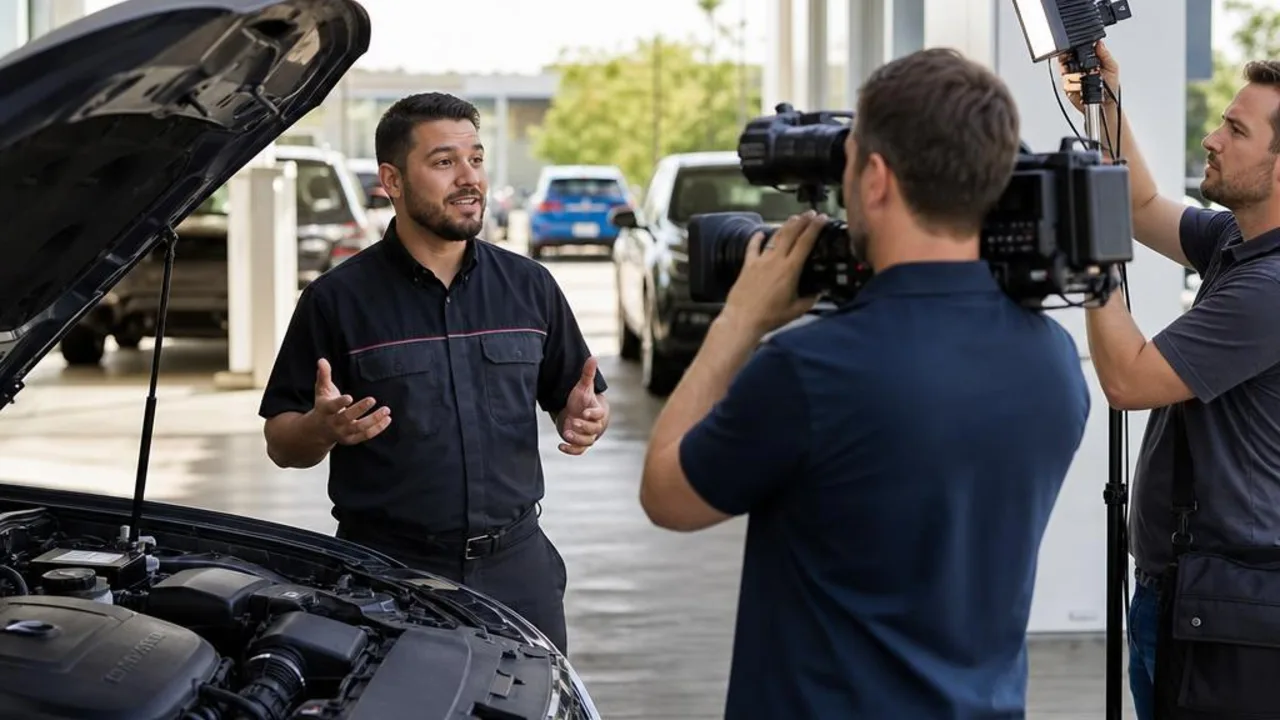
The right presenter is the person who owns the experience being described. A service advisor can explain check-in preparation; a delivery specialist can show technology handoff; a sales manager can explain how availability is confirmed. Give them a briefing, a concise script outline, and a chance to correct process details. Do not force every employee to perform as an influencer. Credible, clear explanation is more useful than a rehearsed personality when the viewer is trying to make a decision.
For multi-rooftop groups, establish what can be shared and what must be localized. A general explanation of vehicle delivery may travel across stores. Store hours, service-lane flow, pricing practices, and staff introductions should not be copied casually. A modular production plan can preserve a common visual system while leaving room for local accuracy.
Distribute by Moment, Then Measure the Next Step
A video’s destination matters as much as its play count. Put a process explainer beside the form or scheduler it supports. Let BDC use approved links when the same question comes up in a conversation. Use paid media to introduce a high-friction topic to the relevant audience, not merely to accumulate views. Create a tracking plan that distinguishes a video view from the downstream action: another page view, a scheduler start, a call, an appointment, or a completed repair order where measurement is available.
Review the system with frontline teams. If a video has high completion but customers still ask the same question, the answer may be too vague or hard to find. If it drives a surge of contacts that the department cannot handle, revise the destination and staffing plan. Content is part of the operating model, not a layer applied after it.
Objection-First Production Checklist
- Build the topic backlog from anonymized operational questions, not only marketing brainstorms.
- Score topics for frequency, customer value, operational readiness, and review requirements.
- Script the question, direct answer, evidence, conditions, and next action.
- Create master and cutdown versions while preserving the same core claim.
- Place each video where the customer encounters that question and track the relevant next step.
- Revalidate videos whenever local process, model details, policies, or offers change.
Want to implement these strategies?
Relevant Dealer can run this exact playbook for your operation.
Talk to an Operator